
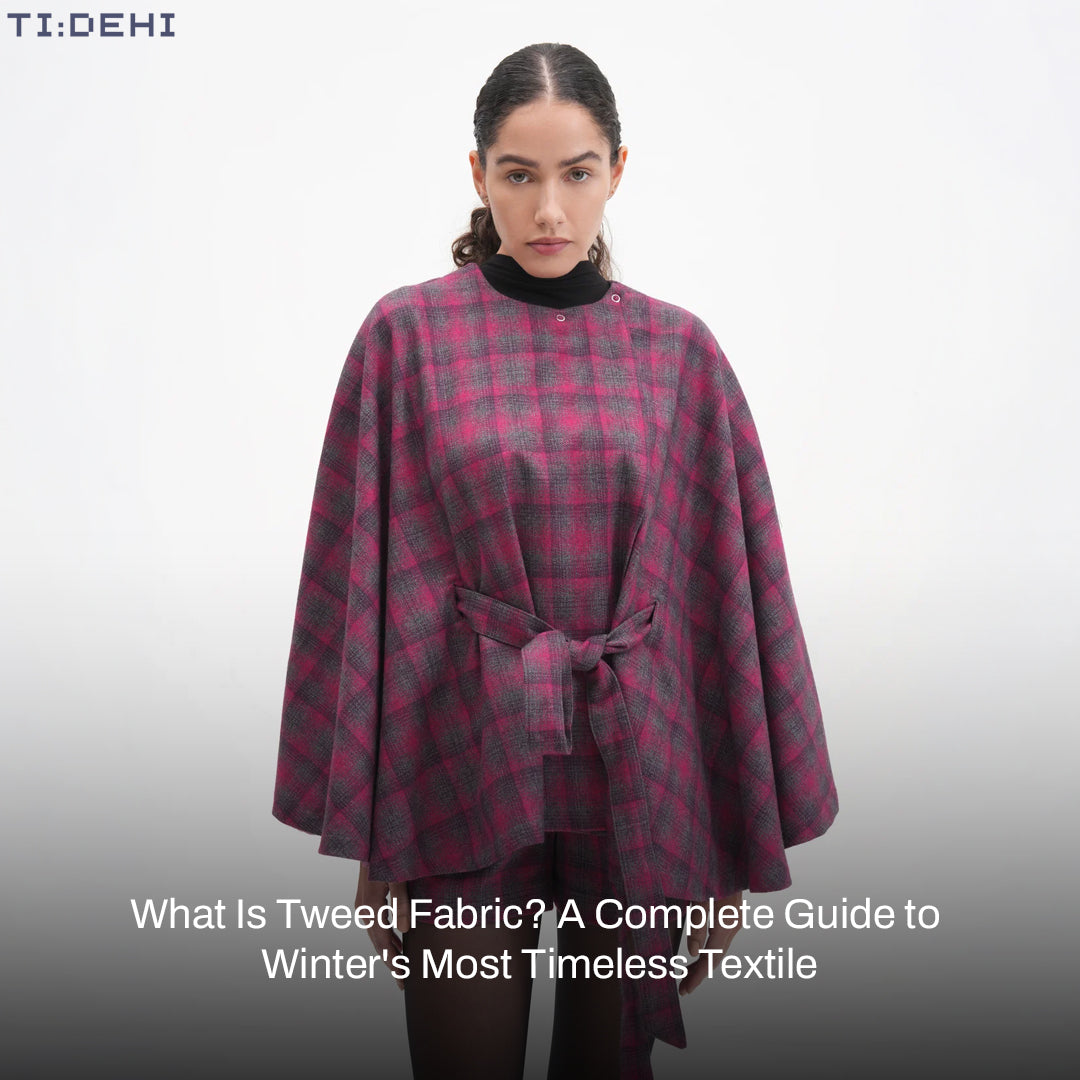
Every winter, tweed makes its quiet comeback — on runways, in office wardrobes, and in the closets of anyone who understands that some fabrics simply don't go out of style. But despite how often we see it, most of us have never actually stopped to ask: what is tweed, where does it come from, and why has it survived over a century of changing fashion?
At DEHI, our entire Winter Edit collection is built around this one fabric story. So instead of just styling it, we wanted to actually explain it — what it is, how it's made, and how we've used it across our own pants, jackets, and skirts this season.
What Is Tweed, Exactly?
Tweed is a rough, woven fabric traditionally made from wool, originally developed in Scotland and Ireland to withstand harsh, damp, outdoor weather. Its defining trait is texture — a slightly coarse, nubby surface created by weaving together wool yarns of different colors, which is also what gives tweed its signature flecked, multi-tonal look.
Unlike smooth wool suiting fabric, tweed is thicker, heavier, and more durable. That's exactly why it became the fabric of choice for outdoor coats and hunting jackets in the 1800s, before eventually working its way into boardroom blazers and, later, womenswear tailoring.
The Origins of Tweed
Tweed traces its roots to the Scottish and Irish countryside, where it was originally handwoven by farmers and estate workers as practical protection against the weather. Its coarse, densely woven structure made it naturally water-resistant and warm — qualities that had nothing to do with fashion and everything to do with survival.
The name itself likely comes from a happy accident: a London merchant misread the Scottish word "tweel" (a local term for twill weave) as "tweed," possibly influenced by the River Tweed running through the Scottish Borders — a region historically known for wool weaving. The name stuck, and so did the fabric.
By the 19th century, tweed had moved from farmland to the wardrobes of British aristocracy. Its association with heritage and old-world elegance carried it into 20th-century fashion — most famously when Coco Chanel reimagined the tweed suit as a symbol of a different kind of power: tailored, structured, and unapologetically feminine. That same duality — practical origins, elevated result — is exactly why we chose it as the foundation of this season's edit.
Tweed vs. Wool: Clearing Up the Confusion
This is one of the most common points of confusion, so let's clear it simply.
Wool is a raw fiber, sourced from sheep. It can be spun and woven into countless fabrics — some smooth, some fine, some heavy.
Tweed is a specific way of weaving that wool. It's typically made by interlacing different colored wool yarns in a twill or plain weave, which is what gives tweed its flecked, textured surface — no two close-up looks at a tweed swatch are ever perfectly uniform.
So tweed is always wool, but not all wool is tweed. When a garment label simply says "Wool," it's often referencing tweed-style weaving without using the word explicitly — which is the case across several pieces in our own collection, like our Girth High-Waisted Woolen Pants.
How Tweed Is Made
Traditional tweed production is a slow, deliberate process, which is part of why it carries a premium feel even in its rougher forms:
-
Wool sorting and dyeing — raw wool fibers are dyed in small batches before spinning, creating tweed's characteristic flecked color effect.
-
Yarn spinning — dyed fibers are spun into yarn, often blending multiple shades within a single thread.
-
Weaving — the yarn is woven on a loom, typically in a twill structure, to create the fabric's textured surface and recognizable pattern.
-
Finishing — the woven cloth is washed, brushed, and pressed to soften it slightly and set its final weight and texture.
This process explains why genuine tweed has a certain heft that's hard to replicate in cheaper wool blends — the weight isn't accidental, it's built in for durability and warmth.
The Main Types of Tweed Patterns
Tweed isn't one single look — it's a family of weaves, each with its own character
Check is the most recognizable tweed pattern — a grid formed by intersecting horizontal and vertical lines. It's the most versatile pattern and the easiest to bring into an everyday wardrobe.
Herringbone gets its name from its resemblance to the skeleton of a fish — a distinctive "V" shaped weave that reads slightly more formal than a check.
Houndstooth is a broken, jagged check — bolder and more graphic, generally considered the most fashion-forward of the three.
Case Study: How DEHI Uses Tweed in the Winter Edit
Rather than using tweed for a single statement piece, we built an entire capsule around it — one core fabric story, expressed across multiple silhouettes and patterns, so every piece is designed to work together.
Tailored Bottoms: Our Girth High-Waisted Woolen Pants use a wide-leg, high-rise cut to let the fabric's structure do the work — the wool holds pleats and shape through a full day of wear, which is exactly the kind of durability tweed was originally designed for. It's available in Grey Herringbone, Black Check, and Brown Check — deliberately chosen so each pair can be mixed with other pieces in the edit rather than worn as a one-off.
Structured Outerwear: The Bae Jacket applies the same wool weave to a cropped, structured silhouette — leaning on tweed's natural stiffness to hold shape without needing heavy interfacing. Available in Champagne Beige, Grey Herringbone, and Pink Checkered, it's built to layer over shirts, waistcoats, or knits.
Relaxed Layering: Not every piece in the edit is tailored. Our Phiran takes the same fabric and reworks it into an oversized, wrap-style layering piece — proof that tweed doesn't have to mean stiff or formal. Available in Black Check and Pink Check.
Why one fabric, many silhouettes: Building the collection this way means every piece is designed to be worn interchangeably — a shirt from one colorway with pants from another, a waistcoat layered over a herringbone shirt — rather than requiring an entirely new outfit for each item. It's a practical approach to how tweed is actually worn today: as a wardrobe system, not a single occasion piece.
An Honest Note on Comfort
Because tweed is a raw, textured wool weave, it can feel slightly coarse against bare skin — this is a genuine, well-documented characteristic of the fabric, not a manufacturing flaw. If you're new to wearing tweed, a smooth base layer (a fitted top, a lining, or a slip) underneath solves this easily while keeping all of the fabric's warmth and structure intact. We'd rather tell you this upfront than have it be a surprise after your first wear.
Why Tweed Remains a Winter Wardrobe Staple
It's genuinely warm. Tweed's dense, twill weave traps heat effectively, which is exactly why it became outdoor workwear in the first place — it outperforms most lightweight synthetic alternatives.
It's durable. A well-made tweed garment doesn't wear thin the way cheaper fabrics do. Tight weaves and quality wool fibers hold their shape through repeated wear.
It holds tailored structure. Because of its weight, tweed holds pleats, structured shoulders, and defined waistlines in a way softer fabrics can't.
It has honest character. Tweed isn't meant to look flawless or uniform. Its slightly irregular, flecked texture is part of the appeal — a reminder that it's woven, not printed.
Shop the Full Tweed Edit
Every piece described above — and more — is part of our Winter Edit collection: wool woven in Check, Herringbone, and Houndstooth, cut into pants, jackets, waistcoats, skirts, and capes designed to work as one coordinated wardrobe. Explore the full collection here →
Frequently Asked Questions
1. What is tweed fabric made of?
Tweed is traditionally made from 100% wool, woven using different colored yarns to create its signature flecked, textured surface. Some modern versions use wool blends, but the weaving technique — not just the fiber — is what defines tweed.
2. Is tweed the same as wool?
Not exactly. Wool is the raw fiber, while tweed is a specific weaving method that uses wool yarn to create a textured, patterned fabric. All tweed is wool, but not all wool is tweed.
3. Is tweed fabric warm enough for winter?
Yes. Tweed's dense, twill weave traps heat effectively, making it one of the warmest natural fabrics available — which is exactly why it was originally developed for outdoor wear in cold, damp climates.
4. Is tweed fabric itchy or uncomfortable to wear?
Tweed has a naturally textured, slightly coarse hand-feel because of its raw wool weave. It's not a flaw — it's inherent to the fabric. Wearing a smooth base layer or opting for lined pieces easily solves this while keeping the warmth intact.
5. What's the difference between check, herringbone, and houndstooth tweed?
Check is a grid pattern formed by intersecting lines and is the most versatile. Herringbone is a "V" shaped weave that looks more formal. Houndstooth is a broken, jagged check that reads bolder and more fashion-forward. DEHI's Winter Edit features all three across pants, jackets, and skirts.


Leave a comment
All comments are moderated before being published.
This site is protected by hCaptcha and the hCaptcha Privacy Policy and Terms of Service apply.