
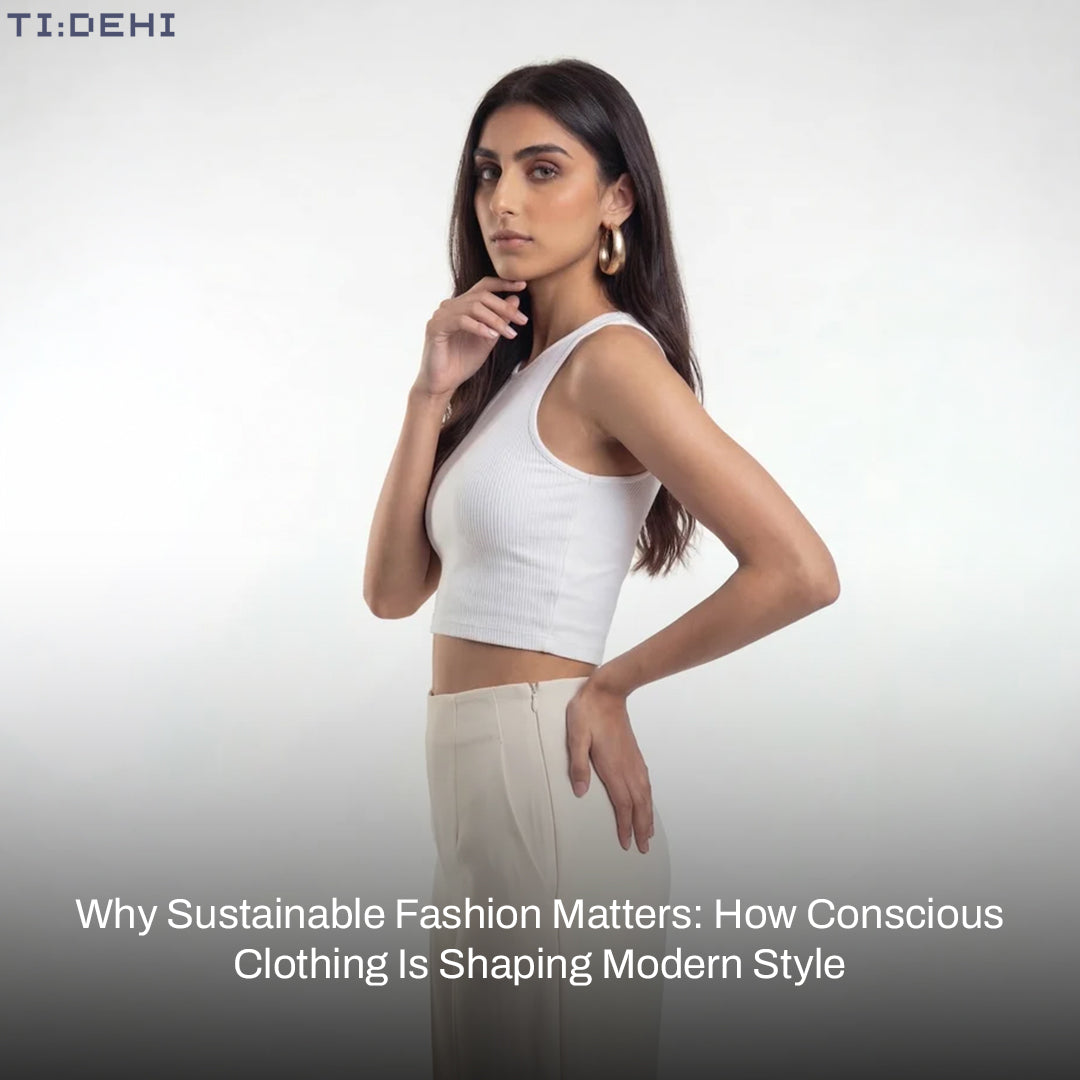
Most of us own more clothes than we did five years ago, and somehow still feel like we have nothing to wear. A dress bought for one wedding sits unworn because there's nowhere else to take it. A trend piece that felt essential in the moment ends up at the back of a drawer within a season. Meanwhile, awareness of what clothing actually costs — not in rupees, but in resources and labour — keeps growing.
This is roughly where sustainable fashion as a conversation starts to matter. It isn't really a shopping category you tick off by buying something labelled "eco-friendly." It's closer to a shift in how you think about clothing altogether — what fabric you choose, how often you shop, how long you keep something, how many ways you can wear it, and what happens to it once you're done. None of this requires a perfect wardrobe. It just asks for a slightly more intentional one.
What Is Sustainable Fashion?
Sustainable fashion gets reduced, pretty often, to a single idea: organic cotton, or a "green" label on a hangtag. In reality, a garment's impact touches almost every stage of its life — the raw material it started as, how it was manufactured, how far it travelled to reach a store, how it's worn and washed, whether it gets repaired or repurposed, and eventually, how it's disposed of.
That's a genuinely long chain, and it's part of why calling any single garment "sustainable" tends to oversimplify things. A shirt made from a responsibly sourced fabric can still have a high footprint if it's washed constantly in hot water and thrown away after six wears. A cheaper, less "sustainable-looking" piece worn for years might do less overall harm than a premium eco-label piece worn twice.
This is why it helps to think of conscious fashion less as a fixed standard to meet and more as a set of better choices made consistently — around fabric, quantity, care, and how long something stays useful in your life.
Why Does Sustainable Fashion Matter?
It Can Help Reduce Clothing Waste
Overproduction is a real issue in the fashion industry — brands routinely make more than gets sold, and a large amount of clothing that is sold gets worn only a handful of times before it's discarded. Every piece that stays in active rotation for longer, instead of being replaced after one season, is one less item adding to that pile.
It Encourages Better Use of Resources
Growing or producing any fabric uses water, energy, and raw materials, and how a garment is made affects how much of each gets used. This doesn't mean every "natural" fabric automatically uses fewer resources than every synthetic one — the picture is more nuanced than that — but thinking about material and production choices at all is a step most shoppers skip entirely.
It Changes How We Think About Trends
Chasing every micro-trend that shows up on a feed tends to encourage buying things you didn't actually need, in order to keep up with a cycle that resets every few weeks. Timeless design works against that impulse — a well-cut piece in a wearable colour doesn't ask to be replaced just because the algorithm moved on to something else.
It Encourages Longer-Lasting Wardrobes
A single versatile piece, worn repeatedly across different settings, often does more for a wardrobe than five trend-specific pieces that only work for one look each. Longevity isn't just about durable fabric — it's also about whether a garment is designed to be worn more than once in the same way.
Sustainable Fashion vs Fast Fashion
The buying mindset differs first — fast fashion tends toward frequent, trend-driven purchases, while sustainable fashion leans toward more intentional, considered ones. The design approach follows a similar split: fast fashion is often trend-focused, chasing whatever's current, while sustainable fashion tends to prioritise longevity over novelty.
This shows up in how long clothes actually stay in use. Fast fashion pieces often go through shorter wear cycles, discarded once the trend fades, while sustainably chosen pieces are built and bought with longer-term use in mind. Materials vary widely across fast fashion, with little consistency in sourcing, whereas sustainable fashion places a greater focus on responsible material choices. And at a behavioural level, fast fashion encourages buying more frequently, while sustainable fashion nudges toward buying more mindfully — fewer purchases, chosen more carefully, valued for versatility and longevity rather than constant novelty.
It's worth being careful here: not every fast-fashion garment causes harm in exactly the same way, and not every sustainable-labelled piece is automatically better across every metric. Sustainability exists on a spectrum rather than a strict for-or-against line, and most of us — brands included — sit somewhere along that spectrum rather than at either end.
Eco-Friendly Clothing: What Should Shoppers Actually Look For?
A label reading "eco-friendly" doesn't tell you much on its own. It's worth looking past the marketing language and checking a few more concrete things: what the garment is actually made of, how well it's likely to hold up over repeated wear, whether the design is versatile enough to earn its place in your wardrobe, how it was produced, what the packaging looks like, and how transparent the brand actually is about its process.
Construction quality matters more than most shoppers realise — seams, stitching, and fabric weight say a lot about whether a piece will last. Expected lifespan and care requirements matter too; a beautiful piece that needs dry-cleaning after every wear has a very different real-world footprint than one you can machine wash and repair easily. None of this requires becoming a textile expert. It just means reading past the word "eco-friendly" itself and checking what's actually behind it.
Ethical Fashion vs Sustainable Fashion
These two terms get used interchangeably a lot, but they're not quite the same thing. Sustainable fashion is mainly about environmental responsibility — reducing waste, resource use, and overall impact on the planet. Ethical fashion brings in a different, equally important set of concerns: how workers are treated, whether they're paid fairly, what their working conditions look like, and how responsible the supply chain is end to end.
A garment can genuinely be strong on one front while still having room to grow on the other. A brand using responsibly sourced natural fibres isn't automatically covering every ethical labour concern in its supply chain, and a brand with strong labour practices isn't automatically minimising its environmental footprint. The two ideas overlap in a lot of places, but treating them as identical oversimplifies both.
How Conscious Fashion Is Changing Modern Style
Timeless Pieces Over Micro-Trends
A classic silhouette — a well-cut trouser, a simple shirt, a straight dress — doesn't age out the way a trend piece does. It can look relevant for years rather than one season, simply because it was never built around a passing moment to begin with.
Versatility Over One-Time Outfits
A single garment that can move between an office day, a casual outing, and a dinner is worth more, practically speaking, than three separate outfits that only work in one specific setting.
Comfort and Functionality
Modern shoppers increasingly want clothing that actually fits how they live — commuting, working, travelling — rather than pieces that only make sense in a photograph.
Quality Over Quantity
Fewer pieces, chosen carefully and worn often, tend to serve a wardrobe better than a larger collection where most items sit unused most of the time.
Personal Style Over Constant Trend-Chasing
A wardrobe built around genuine personal taste, rather than whatever's currently circulating online, tends to hold up better over time — both stylistically and in terms of how much you actually reach for it.
Together, these shifts describe what conscious fashion looks like in practice: not a stricter rulebook, but a different set of priorities guiding what actually gets bought and worn.
How to Build a Sustainable Wardrobe
Step 1: Start with what you already own
Before buying anything new, go through your existing wardrobe honestly. A surprising number of "gaps" turn out to already be filled by something you'd forgotten about.
Step 2: Identify your most-worn pieces
The clothes you reach for again and again usually share something in common — a colour, a fit, a fabric. That pattern is a genuinely useful guide for what to buy more of.
Step 3: Choose versatile clothing
Look for pieces that can move across work, casual outings, travel, and social settings, rather than something designed for one context only.
Step 4: Prioritise fabric and construction
Check how a garment is made, not just how it looks on a hanger — seams, weight, and finish tell you a lot about how it'll hold up.
Step 5: Buy less impulsively
A few honest questions help here: Will I wear this at least 20 to 30 times? Can I style it with at least three things I already own? Would I still want this if it wasn't trending right now? Am I buying it because I need it, or because it's on sale?
Step 6: Take care of clothing
Proper washing, drying, and storage extend a garment's life more than people expect, and small repairs — a loose button, a small tear — are often easier to fix than to replace.
Step 7: Reuse, donate, resell, or repurpose
When something genuinely no longer fits your life, there are usually better options than the bin — passing it on, reselling it, or repurposing the fabric.
Building a sustainable wardrobe this way doesn't mean overhauling everything at once. It's a gradual shift in habits more than a one-time purchase decision.
Does Sustainable Fashion Have to Be Expensive?
Not necessarily — and this is worth addressing directly, since it's one of the biggest reasons people assume sustainable fashion isn't for them. Cost per wear is a genuinely useful way to reframe the question: a moderately priced piece worn fifty times costs far less, per wear, than an expensive piece worn twice.
Buying fewer pieces, choosing versatile garments over occasion-specific ones, resisting impulse purchases, taking proper care of what you already own, considering pre-owned pieces where it makes sense, repairing instead of replacing, and investing more selectively in the pieces you'll genuinely wear often — all of this shapes the actual cost of a wardrobe more than any single price tag does. Sustainability, in this sense, is as much about how often and how thoughtfully we consume as it is about what a specific item costs upfront. It would be inaccurate to claim sustainable fashion is always cheaper — some genuinely sustainable pieces do cost more to produce responsibly — but consuming less and more carefully tends to even that out over time.
How DEHI Fits Into the Conscious Fashion Movement
DEHI is one example of a brand shaped by a lot of these same principles, and it's worth being upfront about what that actually means rather than overselling it. As the brand itself acknowledges, being fully sustainable isn't really achievable for any clothing brand today — it's an ongoing effort rather than a finished state.
In practice, this shows up in a few concrete ways: using natural fabrics like cotton, linen, and wool; using good-quality surplus fabric rather than only newly produced material; recycling or upcycling fabric trims instead of discarding them; avoiding elastics where they aren't genuinely necessary; using cotton labels instead of synthetic ones; metal or wooden buttons instead of plastic; and plastic-free packaging, including cotton bags and corn-starch mailers for online orders. On the design side, DEHI has said it deliberately avoids building collections around micro-trends, aiming instead for pieces meant to stay wearable beyond one season.
None of this means every DEHI piece is perfect on every metric, and the brand doesn't claim that either. It's a reasonable example of what trying — rather than claiming to have solved sustainability — actually looks like in a working wardrobe brand.
Using DEHI Products as Wardrobe Examples
When it comes to versatility, a few DEHI categories illustrate the idea well. A well-cut top — like the Curve Shirt top — or a shirt in a wearable neutral can move between a work day and a casual weekend without much effort. Pieces from the Co-Ord Sets range can typically be worn together for a put-together look or split apart — the top with jeans, the bottom with a different top — which is really the point of versatile design; the Cross Litsea Coord is a good example of this kind of split-and-restyle piece. The Dehi Core edit specifically leans into everyday, office-ready pieces meant to be repeated rather than saved for one occasion — a Waiscoat Pant Set is a straightforward example of a single purchase that covers a full office outfit. The Pants collection includes linen options — like the Girth High-Waisted Linen Pants — built for exactly the kind of repeated, breathable wear this article has been talking about.
A simple, versatile dress — the Sierra Dress is one example — shows a similar idea: a clean silhouette in a solid colour tends to get restyled with different footwear and layers far more often than a heavily printed, occasion-specific piece would. The Kurta edit works the same way — a set like the Mira Kurta Set can move between a festive lunch and a slightly dressed-down evening depending on what it's paired with. None of these are the "one perfect answer" — they're simply concrete examples of the same principles applied to real clothing.
Sustainable Fashion in the Indian Context
Sustainable fashion doesn't look identical everywhere, and India's climate and habits shape it differently than, say, a cooler European context. Hot, humid weather across large parts of the country makes breathable fabrics like cotton and linen genuinely practical rather than just fashionable — they hold up better through repeated daily wear in heat than many synthetic alternatives.
Indian wardrobes also tend to move across a wider range of occasions in a single week — commuting, working, festive functions, travel, casual outings — which makes versatile, repeatable pieces especially useful rather than optional. There's also a long-standing habit, in a lot of Indian households, of repairing and reusing clothing rather than immediately replacing it — getting a tailor to fix a seam, repurposing an old saree, handing down clothes within a family. This isn't a claim about history or tradition in general, just a practical observation: some of what sustainable fashion is asking modern shoppers to (re)learn is already familiar territory for a lot of Indian consumers.
10 Simple Ways to Shop More Consciously
-
Shop your own wardrobe first before buying anything new
-
Avoid impulse purchases, especially on sale
-
Check the fabric composition before buying
-
Choose pieces that work across multiple occasions
-
Look for solid construction — seams, stitching, fabric weight
-
Think in terms of cost per wear, not just price
-
Avoid buying something purely because it's trending
-
Follow the care instructions properly
-
Repair small issues before replacing the whole garment
-
Donate, resell, or repurpose clothing responsibly when you're done with it
Common Myths About Sustainable Fashion
Myth 1: Sustainable fashion means wearing only natural fabrics
Material choice matters, but it's one factor among several — durability, versatility, and how a garment is produced all play a role too. Natural fibres aren't automatically the better choice in every single case.
Myth 2: Sustainable clothing must be expensive
Cost per wear, buying fewer pieces, and taking care of what you own all shape the real cost of a wardrobe more than any individual price tag.
Myth 3: Buying "eco-friendly" automatically makes a wardrobe sustainable
Buying a lot of eco-labelled pieces you rarely wear isn't meaningfully different from buying a lot of anything else you rarely wear. Quantity and actual use matter as much as the label.
Myth 4: You need to replace your entire wardrobe
The most sustainable starting point is usually what's already in your cupboard, not a fresh set of purchases branded as more responsible.
Myth 5: Sustainable fashion cannot be stylish
Timeless silhouettes, considered colour choices, and versatile pieces are entirely compatible with personal style — arguably more so than constantly rotating trend pieces that all start to look similar after a while.
What to Ask Before Buying a New Piece
- Do I genuinely need it?
- How often will I realistically wear it?
- Does it work with clothes I already own?
- Is the fabric suitable for my day-to-day lifestyle?
- Can I style it in more than one way?
- Is it likely to stay useful beyond a single trend cycle?
- Is the garment actually well made?
- Can I care for it properly, realistically?
- Am I buying this because I like it, or because everyone else seems to have it?
Conclusion
Sustainable fashion was never really about achieving a perfect, guilt-free wardrobe. It's about becoming a little more intentional — about what you buy, how often you wear it, how you take care of it, and how long you keep it around before it gets replaced.
That mindset doesn't require overhauling everything overnight, and it doesn't require choosing between style and responsibility. Brands like DEHI, built around comfortable, versatile, and reasonably timeless clothing, are one example of what it looks like to make that kind of thinking more accessible — not as a finished solution, but as an ongoing, honest effort to do a little better.
FAQ’s
What is sustainable fashion?
Sustainable fashion refers to clothing choices and industry practices that aim to reduce environmental impact across a garment's full lifecycle — from raw materials and production to how long it's worn and how it's eventually disposed of. It's less a fixed label and more a set of better, more intentional choices.
Why is sustainable fashion important?
It matters because clothing production and disposal contribute to resource use and waste at a large scale. Choosing more durable, versatile pieces and buying more intentionally can reduce that impact, even if no single choice solves the issue on its own.
What is the difference between sustainable fashion and ethical fashion?
Sustainable fashion focuses mainly on environmental impact, while ethical fashion focuses on worker treatment, fair wages, and responsible supply chains. The two overlap often, but a garment can be strong on one front while still improving on the other.
What is conscious fashion?
Conscious fashion describes shopping and dressing with more awareness — considering versatility, longevity, and genuine need rather than following every trend. It emphasises thoughtful decisions over any single certification or label.
What is eco-friendly clothing?
Eco-friendly clothing generally refers to garments made with more responsible materials or production methods. However, the label alone isn't a guarantee — durability, versatility, and how often a piece actually gets worn matter just as much.
How do I build a sustainable wardrobe?
Start by auditing what you already own, identify pieces you wear most often, and prioritise versatile garments over occasion-specific ones going forward. Buy less impulsively, care for clothing properly, and pass on what you no longer need responsibly.
Is sustainable fashion expensive?
Not necessarily — thinking in terms of cost per wear often shows that fewer, well-chosen pieces cost less over time than frequent cheaper purchases. Some sustainably produced pieces do cost more upfront, but buying less overall tends to balance that out.
How can I make my wardrobe more sustainable?
Focus on versatile, well-made pieces you'll actually wear repeatedly, avoid impulse buying, take proper care of your clothes, and consider repairing or repurposing before replacing. Small, consistent habits matter more than any single purchase.
Leave a comment
All comments are moderated before being published.
This site is protected by hCaptcha and the hCaptcha Privacy Policy and Terms of Service apply.